

Make the best ugali! This Kenyan recipe is absolutely easy to put together, and makes for the perfect side dish as it can be served with so many dishes!

*This post may contain affiliate links — as an Amazon Associate I earn from qualifying purchases, at no extra cost to you.
I always get excited when I get to share recipes from my birth country Kenya; as East-African food is just amazing! New here? Then you definitely want to check out my Swahili Kenyan Pilau, Githeri, Ndengu, and Chapati recipes.
You will also find a collection of African dishes to browse through. These are all packed with flavour, and use readily available ingredients so I am sure you will love them all!
Jump to:
what is ugali?
Ugali is a dish made by cooking maize flour (course cornmeal similar to polenta in texture) into a type of mush. It is a popular meal in most African countries where it goes by different names.
It has a very neutral taste, similar to unflavoured popcorn. Some people actually find it to be tasteless but this totally depends on the palate. Due to its relatively neutral taste, and ease of preparation, it is popularly served as a side dish alongside vegetables such as sukuma wiki (collard greens), soups, and stews. In Kenya, ugali is considered one of the national dishes and is eaten almost daily.
Ugali has important vitamins and minerals from maize flour or meal and is healthy to eat. 100 grams (or ½ cup) has 398 calories comprising 77 grams of carbohydrates, 10.4 grams of fiber, and 5 grams of fat. This means that it is a healthy, fiber-packed food that you can incorporate into your diet. However, seeing that this is mostly carbohydrates, it is considered to be low in terms of nutrition content, when consumed on its own and it is recommended to serve it with healthy vegetables and protein, for a balanced meal.
ugali ingredients

You only require two ingredients to make ugali:-
- coarse cornmeal (maize flour) - traditionally white maize flour is used to make ugali in East Africa, but the color of maize flour doesn't matter so feel free to use the yellow variety if that is what you have around. In Europe and the States, you can easily get it in the African and Asian markets under the name white corn flour, coarsely ground cornmeal, or simply white maize flour.
- water
This is a summary of the ingredients needed to make ugali, as well as possible options for substitution, if any. The full ingredient measurements and step-by-step instructions have been provided in the recipe card provided below.
how to make ugali
- Step 1: Boil water in a pot.
- Step 2: Add cornmeal, a little at a time and stir.
- Step 3: Continue stirring, the mixture will form a dough-like consistency as it cooks. Break any lumps that form by pressing them on the sides of your pot.
- Step 4: Shape the ugali, remove it from the heat, and transfer it to a plate and serve.
what to serve with ugali
When it comes to serving ugali, any type of savory stews, soups, stir fries, grilled meats, poultry and fish works great. For a true Kenyan feel, serve ugali with Nyama Choma, Kenyan Beef stew, Kuku Choma, Sukuma Wiki, Kachumbari, Samaki wa Kupaka, chicken stew, or your favorite vegetables.
useful tips
- Ugali can also be made using sorghum, cassava or millet flour.
- Ugali is best made using a flat wooden spoon, known as mwiko in Swahili. It is something that never misses in an African household and is actually a kitchen utensil that has been used in several Swahili proverbs. Don't worry if you don't own a mwiko as you can, however, still use any other type of wooden spoon.
- You will know the ugali is cooked when it easily pulls away from the bottom of the pot and starts to give a strong aroma of corn. A small ball pinched between the thumbs will not be too sticky or grainy. Also, an unproven theory is that a ball of ugali that has cooked through, will not stick when thrown against a wall and will instead fall down.

more delicious Kenyan recipes to try!
Try out our other East- African recipes!
- Mandazi - delightful East African buns that are just sweet enough. I like to have mine with some tangawizi chai (ginger tea with milk), but let me know in the comments section how you like to have yours!
- Chips Masala - say goodbye to boring fries with this spiced fries recipe.
- Mahamri - cardamon and coconut-infused buns.


📖 Recipe

Ugali Recipe
Video
Equipment
Ingredients
- 2 cups maize flour (coarse cornmeal)
- 4 cups water
Instructions
- Using a medium-sized and deep pot, bring water to boil. Once boiling, reduce the heat to low and set ½ a cup of water aside.4 cups water
- To the pot, add the maize flour (cornmeal), a quarter of a cup at a time, and use a wooden spoon to stir, using circular motions. At this point, it should be slightly thick and resemble porridge.
- Continue adding the maize flour (cornmeal) a little at a time, and stirring until all of it has been used up and the mixture is firm. This will take about 5 minutes.
- Using the wooden spoon, poke small holes on the surface of the ugali and add the previously preserved hot water to the holes. Next, cover and allow to cook for a further 5 minutes stirring halfway through, or until all the water has evaporated and the bottom of the pan is browned up but not burning.
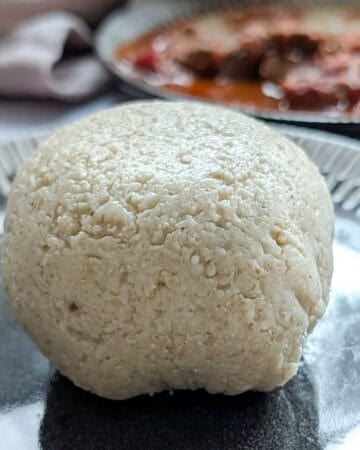
- Use the wooden spoon to transfer the ugali to the side of the pot. You will know the ugali is cooked when it easily pulls away from the bottom of the pot and starts to give a strong corn aroma. A small ball pinched between the thumbs will also feel slightly sticky and not grainy.
- Finally, run the wooden spoon under tap water (this helps with the shaping). Shape the ugali in the pot until you have something that resembles a round ball.
- Take the pot from the stove and tip it upside down onto a plate, so the ugali now falls to the plate. You can shape it again using a wooden stick. Serve ugali while hot with Kachumbari, nyama choma, sukuma wiki, or your favourite dishes.
Notes
- While the authentic recipe uses no butter, margarine, or salt, feel free to add this if you prefer. You can also enrich it by using milk or cream.
- Store leftover ugali in the fridge for 3-5 days. You can also keep it in the freezer for up to 6 months.
Nutrition
frequently asked questions
The two are actually different. Although both are starchy side dishes eaten in most African countries, fufu, which also goes by the name foufou or foofoo, differs from ugali in that it is made from cassava tubers (yuca) or yam. Ugali, on the other hand, is made by cooking maize flour (cornmeal) in boiling water and stirring until it forms a dense ball.
Fufu is made by blending or pounding peeled starchy tubers (normally cassava (yuca) or yam tubers) into a thick batter, which is then cooked until it reduces to a stretchy form. Once cooked, fufu is normally shaped into balls and served with stews and soups, such as egusi. Additionally, fufu is less compact or dense than ugali and more stretchy.
Cooled ugali will form a thick layer on the surface, especially when it has been out longer than a day. Before reheating, peel this layer so it can heat up properly. You can easily reheat ugali as follows:
using a pan - you can easily warm ugali without a microwave by using a pan. Simply heat a pan, then add 2 tablespoons of cooking oil. Once the oil has heated, slice ugali into medium slices and pan-fry each side for 3-5 minutes. You can test one by cutting through; it should be all warmed up. Otherwise, simply pan-fry for a further 2-5 minutes.
in the microwave - slice into thick pieces (each similar to the size of a serving of cake), place in suitable microwave-friendly containers, and reheat at 600 watts for 2 minutes. It should be heated through to the middle. If not, simply pop it back in the microwave for another 1-2 minutes.
re-cooking - you can also give leftover ugali new life by entirely recooking it. Simply slice leftover ugali into small pieces and add this to boiling water. Stir using a wooden spoon and once it bubbles, add new cornmeal and cook as per this recipe.
Enriqueta E Lemoine
I have to try ugali. I love learning about different gastronomies. I'm surprised about this polenta-style dish. I'm a corn lover and come from a country like Venezuela, where corn is everything. Thanks for the recipe.
Kate Hahnel
I, just like you, love exploring food from other cultures! I am glad you came across this recipe and hope you will enjoy serving it with your favorite stews, curries, and so much more!
Dee
Wow. I've never had ugali. I love that it involves just two ingredients. Thanks for sharing. Will make this for sure!
Jenny
A dear Kenyan friend made ugali for us a while back and we enjoyed it so much with a beef stew. This is the same recipe! That's so great, I can make it again. Thanks so much!
Jacqueline Debono
I have never had ugali but it looks and sounds very similar to the way we cook and eat polenta here in Italy. On my to try list!
Kate Hahnel
That's true, Italians have something similar. We travelled to Italy last year and it was the only thing I was having as a side. Let me know how it went, once you have tried your ugali.
Ann
I have not heard of ugali before. I was surprised by the very few ingredients needed. Sounds pretty simple to make too.
Loreto and Nicoletta
We love learning about recipes from different countries. This us so great and would be a great side to a very spicy flavorful meal. Also very budget friendly! Great share!
Katie Crenshaw
This was my first time making Ugali and it turned out delicious! Your steps were so easy to follow.
Kate Hahnel
Thank you! I am glad you liked it!